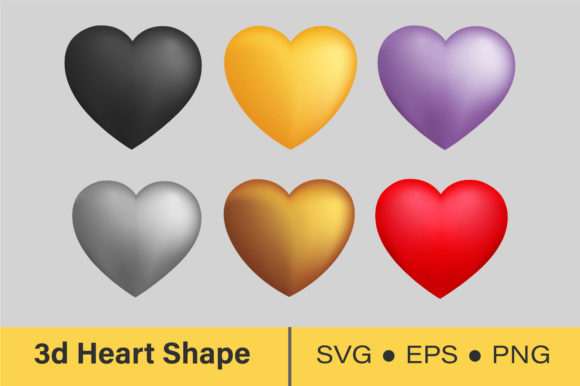
Evaluating the 3D Heart Shape in SVG, EPS, and PNG Formats for Professional Design Projects
Selecting the right graphic asset is rarely a simple decision. For designers, developers, and creative professionals working on projects ranging from wedding invitations to web interfaces, the distinction between file formats often dictates the quality, scalability, and versatility of the final output. When searching for a 3D Heart Shape, users are typically looking for more than just a flat icon; they seek depth, realism, and visual impact. However, the medium through which this shape is delivered—whether as an SVG, EPS, or PNG—fundamentally changes how it can be used, edited, and integrated into broader design systems.
This analysis explores the practical implications of choosing a 3D heart graphic in these specific vector and raster formats. By understanding the technical nuances of each format, creators can make informed decisions that align with their project requirements, ensuring that the aesthetic appeal of the 3D effect does not come at the cost of functional flexibility.
The Appeal of the 3D Heart Shape in Modern Design
A 3D Heart Shape differs significantly from traditional flat icons or simple line art. It utilizes shading, gradients, shadows, and highlights to create an illusion of volume and depth. This stylistic choice makes it particularly effective for themes related to romance, health, charity, and luxury branding, where emotional resonance and tactile realism are desired. Unlike flat designs, which rely on minimalism, 3D graphics demand high-quality rendering to avoid looking muddy or overly complex when scaled down.
The core challenge for any designer is maintaining the integrity of these 3D effects across different media. A heart that looks stunning on a large print banner may lose its detail if resized for a mobile app icon. Therefore, the choice of file format is not merely a technicality; it is a strategic decision about how the asset will behave in various contexts. The availability of multiple formats—specifically SVG, EPS, and PNG—provides a toolkit for handling these varying needs, but each serves a distinct purpose.
Scalability and Editability: The Role of SVG and EPS
When evaluating vector-based options, the primary consideration is scalability. Both SVG (Scalable Vector Graphics) and EPS (Encapsulated PostScript) files store mathematical instructions rather than pixel data. This means a 3D Heart Shape saved in either format can be enlarged to the size of a billboard without losing sharpness or introducing pixelation. However, their internal structures and use cases differ.
SVG: The Web-First Vector Standard
SVG has become the dominant format for digital design due to its native compatibility with web browsers and modern design software like Adobe Illustrator, Figma, and Sketch. An SVG file containing a 3D heart is essentially code-based. This offers several distinct advantages:
- CSS Manipulation: Because SVGs are XML-based, their colors, strokes, and even certain gradient stops can be manipulated directly via CSS. This allows developers to change the color of a 3D heart on hover states or theme switches without needing to generate new image files.
- Small File Size: For simple geometric shapes, SVGs are often smaller in file size than high-resolution PNGs, leading to faster page load times—a critical factor for SEO and user experience.
- Accessibility: SVG elements can be tagged with ARIA labels and semantic HTML, making them accessible to screen readers, which is a growing requirement for compliant web design.
However, complex 3D effects achieved through heavy filtering or mesh gradients can sometimes bloat the SVG code or cause rendering inconsistencies across older browsers. If the 3D heart relies on complex raster-like filters within the vector structure, performance may suffer.
EPS: The Print Industry Legacy
EPS is an older vector format that remains deeply entrenched in the printing industry. While less common in web development, an EPS file is often the preferred source file for professional printers. If your project involves large-format printing, such as banners, signage, or packaging, EPS ensures that the 3D heart retains its crisp edges and vector properties during the pre-press process.
The tradeoff with EPS is editability in digital workflows. Many modern web-focused tools do not support EPS natively. Furthermore, EPS files can sometimes carry over unnecessary metadata or complex postscript code that might not translate perfectly into non-Adobe software. For pure print work, EPS is robust, but for hybrid digital-physical campaigns, SVG often provides a more versatile bridge.
Raster Precision: The Case for High-Quality PNG
While vectors offer infinite scalability, they do not always capture the nuanced lighting and texture of a photorealistic 3D render. In some cases, the "3D" effect is so complex that converting it entirely into vector paths results in a bloated, unmanageable file. This is where PNG (Portable Network Graphics) becomes essential.
A PNG file is a raster image, meaning it is composed of a fixed grid of pixels. When you download a 3D Heart Shape in PNG format, you are getting a snapshot of the 3D model at a specific resolution. The key advantage of PNG over JPEG is its support for transparency. A transparent PNG allows the 3D heart to sit cleanly on top of any background color or pattern without a white box surrounding it.
When PNG is the Right Choice
- Complex Textures: If the 3D heart features intricate metallic reflections, glass refractions, or soft shadows that are difficult to replicate with vector gradients, a high-resolution PNG preserves these details exactly as intended.
- Consistency Across Platforms: Rendering engines in different web browsers can interpret SVG filters differently. A PNG guarantees that the heart looks identical on Chrome, Safari, Firefox, and mobile devices, as it is treated as a static image.
- Quick Integration: For non-designers or simple CMS updates, dragging and dropping a PNG is often faster than importing, editing, and exporting vector files.
The limitation, of course, is scale. If you need to use the same PNG heart on both a favicon and a poster, you will need two different files. A single PNG cannot serve both purposes effectively without compromising quality or file weight.
Comparative Analysis: Decision Factors for Creators
To choose the best format, one must weigh the tradeoffs between editability, fidelity, and workflow efficiency. Below is a practical comparison to guide the selection process.
Workflow Compatibility
If your team uses a stack of modern web technologies (React, Vue, Tailwind), SVG is likely the superior choice. It integrates seamlessly into component libraries and allows for dynamic styling. Conversely, if your workflow is anchored in traditional desktop publishing (InDesign, Photoshop) for print-heavy deliverables, EPS and high-res PNG assets will integrate more smoothly into established templates.
Fidelity vs. Performance
A 3D Heart Shape in SVG format attempts to recreate the look of 3D using math. This is efficient but can sometimes look "flat" if the vector artist lacks advanced skills in creating realistic gradients. A PNG version, however, might be a screenshot from a 3D modeling software like Blender or Cinema 4D. It will have higher visual fidelity but lacks the ability to be reshaped. For a hero banner where visual impact is paramount and scaling is limited, the PNG may be the better aesthetic choice. For a responsive website layout where the heart must adapt to various screen sizes, the SVG is functionally necessary.
Future-Proofing
Consider the lifespan of the asset. Vectors (SVG and EPS) are future-proof regarding resolution. As screens become denser (Retina displays, 4K monitors), vector assets remain sharp without requiring updates. Raster assets (PNG) require higher resolution versions to maintain clarity on new hardware. If you anticipate your designs being viewed on high-density displays, prioritizing vector sources is a prudent long-term strategy.
Best Practices for Implementation
Regardless of the format chosen, proper implementation ensures the 3D Heart Shape performs well. For SVGs, always clean up the code before deployment. Remove unnecessary layers, unused definitions, and excessive comments to reduce file size. Use `
For PNGs, ensure you are using the highest resolution available relative to the display context. A 1x PNG will look blurry on a 2x Retina display. Look for assets labeled "2x" or "4x" if available, or prepare to upscale carefully. Additionally, compress PNGs using tools like TinyPNG to minimize bandwidth usage without noticeable loss in quality.
When working with EPS files, verify the version compatibility with your printing vendor. Older EPS files may not support newer color profiles or transparency settings required by modern offset or digital presses.
Conclusion
The decision between SVG, EPS, and PNG for a 3D Heart Shape is not about finding a single "best" format, but rather matching the tool to the task. SVG offers unparalleled flexibility for web and interactive design. EPS remains a reliable standard for print production. PNG provides guaranteed visual consistency and handles complex textures that vectors struggle to replicate.
By understanding these distinctions, designers and developers can build more robust, scalable, and visually compelling projects. Whether you are crafting a romantic e-commerce site, a health awareness campaign, or a luxury brand identity, selecting the appropriate format for your 3D heart asset ensures that your creative vision is executed with precision and professionalism.